
TLDR
The best labels for subscription boxes depend on where and how the label will be used.
Use a durable branded label on the outside of the box, a carrier-approved shipping label for delivery, roll or sheet labels for individual products, and smaller stickers for tissue paper, inserts, or box seals. Test every label on the actual packaging before ordering a large quantity.
A customer sees the box before they see anything inside it.
That first impression does not require an expensive custom-printed mailer. A plain box with a clean, well-placed label can look intentional, recognizable, and ready to open.
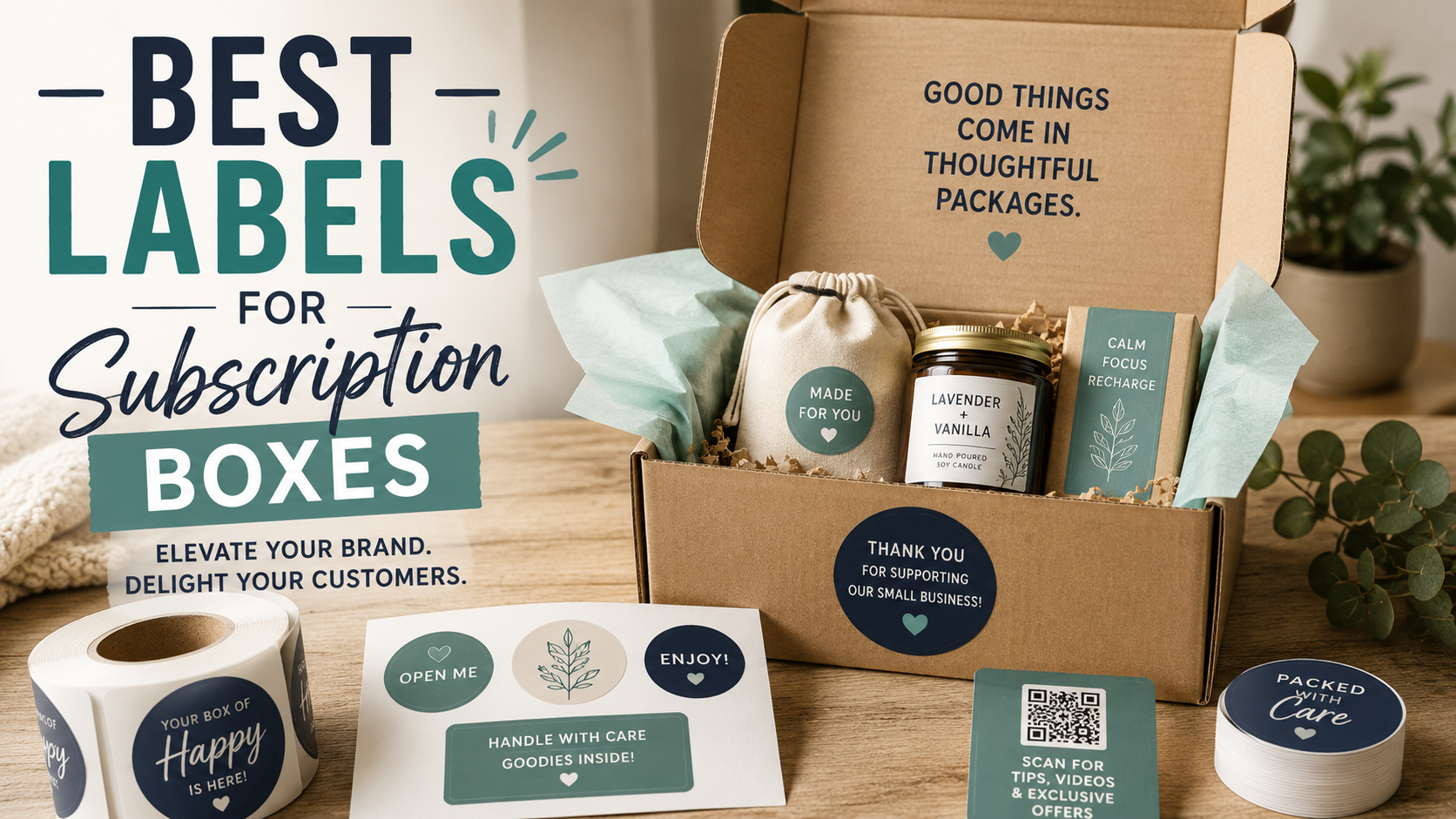
The best labels for subscription boxes also do more than display a logo. They help identify products, organize fulfillment, protect packages, share instructions, and guide subscribers toward their next action. The right setup is usually a small system of labels rather than one sticker trying to do every job.
What Are the Best Labels for Subscription Boxes?
For most subscription businesses, the best label setup includes four parts:
- A branded exterior box label
- A standard shipping label
- Product or inventory labels
- An interior seal or thank-you sticker
Additional labels may be useful for QR codes, product care instructions, allergens, sizes, scents, flavors, batch numbers, or limited-edition items.
Here is a practical starting point:
| Label Use | Recommended Format | Best For |
|---|---|---|
| Exterior box branding | Durable vinyl or plastic label | Logos, box branding, monthly themes |
| Product identification | Roll or sheet labels | Names, variants, ingredients, instructions |
| Shipping information | Direct thermal shipping label | Addresses, tracking, carrier barcodes |
| Tissue or box seal | Paper or vinyl sticker | Sealing tissue, envelopes, and inner packaging |
| QR code label | Matte or low-glare label | Instructions, videos, account pages, reorder links |
| Security seal | Tamper-evident or permanent label | High-value, regulated, or sensitive products |
| Customer freebie | Individual die-cut sticker | Brand awareness and subscriber gifts |
The exact combination depends on what is being shipped. A snack subscription, book box, cosmetics kit, and hobby crate will not need identical labeling.
But each label should have one clear purpose.
Branded Exterior Labels Are the Best Starting Point
A large exterior label is often the most useful label for a new subscription box business.
It allows the company to order standard corrugated boxes and add its branding later. That is helpful when order volume is still changing or when the business uses several box sizes.
Exterior box labels can include:
- The company logo
- A short brand message
- The subscription box name
- A seasonal design
- A monthly theme
- Social media information
- A simple call to action
- Handling or opening instructions
Keep the design clear. A customer should be able to recognize the brand without stopping to read a paragraph.
For most boxes, a circle, square, rectangle, or simple die-cut logo works well. Highly detailed shapes can look interesting, but they may take longer to apply and can have narrow areas that lift more easily from textured cardboard.
Durable packaging and label stickers are a practical option when the exterior label may encounter abrasion, moisture, or repeated handling during delivery. CustomStickers.com offers laminated vinyl packaging stickers with permanent adhesive and resistance to water and oil.
Roll Labels Work Best for Repeated Packing
Roll labels are generally the best option when the same design must be applied hundreds or thousands of times.
The roll format keeps labels organized and makes them quick to peel. It can support hand application at a packing table or machine application as the subscription business grows.
Good uses for roll labels include:
- Branding the outside of every box
- Labeling bottles, jars, tins, or pouches
- Marking product variants
- Sealing tissue paper
- Adding batch or flavor information
- Identifying monthly themes
- Applying the same QR code to every shipment
Custom roll labels may be available in paper, white plastic, and transparent plastic materials. Die-cut roll labels can also follow a custom shape rather than using a standard circle or rectangle.
Roll labels make the most sense when the design is settled. If the branding, product lineup, or box size changes every month, ordering a large roll of one permanent design may create waste.
Sheet Labels Are Better for Small Runs and Many Variants
Sheet labels are useful when a business needs flexibility.
A sheet can contain one repeated design or several different labels. That makes sheet labels a good choice for small subscription programs, test boxes, seasonal products, and businesses that pack several variants at the same station.
For example, a beauty subscription box may need labels for:
- Dry skin
- Oily skin
- Sensitive skin
- Fragrance-free
- Light, medium, and deep shades
A snack box might use one sheet containing separate labels for allergens, spice levels, product names, and expiration dates.
Sheet labels are also easier to store in a filing cabinet or flat packaging drawer. They do not require a label dispenser, and packers can see several designs at once.
CustomStickers.com offers custom labels in both roll and sheet formats. Its die-cut sheet labels are printed on sheets and use vinyl designed to withstand exposure to oil, water, heat, food, and refrigeration.
Shipping Labels Should Stay Separate From Branding Labels
A shipping label is an operational label. Its main job is to help the carrier route and deliver the package.
Do not redesign the carrier label to match the rest of the packaging. Do not add decorative patterns behind the barcode or place promotional stickers where they could interfere with scanning.
Instead, reserve a flat, open area of the box for the shipping label. Then place the branded subscription box label elsewhere.
For USPS packages, the shipping label should be placed parallel to the longest side of the package. USPS also advises keeping labels on the same side and avoiding folds, overlaps, or placement over an edge.
A simple box layout might use:
- Shipping label on the upper-right section
- Brand label on the upper-left section
- Security seal across the front opening
- Handling information on a side panel
Create a placement guide for packers. It prevents labels from moving around from shipment to shipment and keeps the presentation consistent.
Box Seal Labels Add Branding and Function
A seal sticker can close tissue paper, hold an envelope shut, or bridge the opening of a subscription box.
This small label tells the customer where to open the packaging. It can also make the contents feel organized without adding another printed box or insert.
Good seal messages include:
- Packed for you
- Open here
- Your monthly box has arrived
- Made with care
- Thanks for subscribing
- Start here
- A little something for you
A permanent sticker can provide a stronger seal, but it may tear tissue paper or leave residue on reusable packaging. A lighter paper sticker may be enough when the purpose is mainly decorative.
Do not use a standard decorative sticker as a security claim. A normal sticker can show that a flap was closed, but it is not necessarily tamper-evident.
Products that require visible evidence of opening may need a material designed specifically for tamper detection.
Product Labels Keep the Box Easy to Understand
A subscription box can contain several unfamiliar products. Good product labels prevent customers from guessing what everything is.
A product label may include:
- Product name
- Brand name
- Size or quantity
- Flavor, color, or scent
- Instructions
- Ingredients
- Allergens
- Care information
- Expiration or best-by date
- Batch number
- Country of origin
- Required warnings
Some of that information may be legally required depending on the product. Food, cosmetics, supplements, candles, children’s products, and household chemicals can have different labeling requirements.
The subscription box label should not replace required product labeling. If a box contains third-party goods, keep the manufacturer’s original labels visible unless the business has a valid reason and process for replacing them.
For curated items, a small secondary label can explain why the product was selected or how it fits the month’s theme.
QR Code Labels Can Reduce Packaging Clutter
A QR code can move secondary information off the box and onto a webpage.
Useful destinations include:
- A subscriber account page
- Setup instructions
- A demonstration video
- Recipes
- Product care guidance
- A playlist
- A reading guide
- A monthly digital booklet
- Reorder information
- Referral rewards
- Feedback forms
Send the customer to a specific page. A QR code that leads to the company homepage usually makes the customer search for the information all over again.
Keep the code away from folds, corners, textured areas, and reflective finishes. Use strong contrast and leave open space around the code.
Test the printed label with several phones before approving a large order. Scan it in bright light, dim light, and while the label is attached to the actual box.
Choose Label Materials Based on the Surface
The package surface matters as much as the design.
Corrugated cardboard can be rough, dusty, recycled, coated, or uncoated. A label that works on a smooth white mailer may not perform the same way on a textured kraft box.
Paper Labels
Paper labels work well for dry interior packaging, tissue seals, envelopes, and brands that want a softer printed look.
They are not usually the first choice for packages exposed to moisture, oil, or heavy handling.
White Plastic or BOPP Labels
Plastic labels are a practical choice for product packaging and exterior branding. They generally handle moisture and routine abrasion better than basic paper.
A white background also keeps printed colors consistent across brown, black, or colored boxes.
Clear Labels
Clear labels can create a printed-on-box appearance, especially on smooth white or light-colored packaging.
But the box color will affect the design. Transparent areas disappear into the package, and dark cardboard can make colors or small text hard to read. White ink under the design may be needed to preserve contrast.
Clear labels also show trapped dust, fibers, and application bubbles more easily. The surface should be clean before application.
Vinyl Stickers
Laminated vinyl is useful for durable exterior branding, promotional stickers, and customer freebies.
It may be more material than necessary for a simple interior tissue seal, but it works well when the sticker needs to survive after the box is opened.
Match the Label Size to the Box
A label should look deliberate rather than lost or oversized.
Start by measuring the flat printable area of the box. Do not measure across seams, folds, tape, or openings.
Then print the proposed design on ordinary paper at actual size. Cut it out and place it on the box.
Check it from several distances.
A small logo may look refined on a computer screen but nearly disappear on a large shipping box. A large label may look strong from the front but leave no clear space for postage.
Useful starting ranges include:
- 1 to 2 inches for tissue seals and small product labels
- 2 to 3 inches for jar labels, pouches, and small mailers
- 3 to 5 inches for exterior subscription box branding
- Larger rectangular labels for box-top artwork or detailed information
These are starting points, not fixed rules. The design, message, and box proportions matter more than choosing a standard size.
Build a Consistent Subscription Box Label System
Consistency makes separate labels feel like part of one package.
Use the same:
- Logo treatment
- Primary fonts
- Brand colors
- Illustration style
- Border style
- Tone of voice
- Icon system
- General layout
But give each label a different job.
The exterior label can focus on recognition. The product label can focus on information. The tissue seal can be personal. The QR code label can direct an action.
Trying to fit the logo, product list, social handles, thank-you message, QR code, referral offer, care instructions, and legal copy onto one sticker usually produces a small square of administrative panic.
Separate the information instead.
Design Labels for Fast Fulfillment
Good packaging should be easy for employees to assemble correctly.
A label design may look excellent but still create problems if packers cannot distinguish similar products or peel labels quickly.
Before ordering, consider:
- How many labels go on each box?
- In what order are they applied?
- Are different variants easy to distinguish?
- Can labels be peeled while wearing gloves?
- Will one roll be confused with another?
- Where will label inventory be stored?
- Can the design be applied straight without measuring?
- Does the box need space for a packing slip or return label?
Color coding can help, but do not rely on color alone. Add clear product names, initials, numbers, or symbols.
For example, a candle subscription might use:
- Blue plus “OCEAN”
- Green plus “FOREST”
- Orange plus “CITRUS”
That is easier to verify than three labels that differ only by a subtle color shift.
Common Subscription Box Label Mistakes
Using One Label for Everything
Branding, shipping, safety, product identification, and customer messaging are different tasks. Separate them when necessary.
Applying Labels Over Seams
Labels placed over box openings, folds, or edges are more likely to lift, tear, or interfere with opening.
Ordering Before Testing the Box
Always test the label on the exact box material. A digital mockup cannot show texture, adhesive performance, or real printed scale.
Making Text Too Small
Customers should not need a phone camera to read ordinary product instructions.
Overusing Specialty Finishes
Holographic, glitter, chrome, and clear materials can work well for the right subscription theme. They become distracting when every label competes for attention.
Linking a QR Code to the Homepage
Send subscribers directly to the instructions, offer, or monthly content promised by the label.
Forgetting the Shipping Label Area
Plan branding around the carrier label, not the other way around.
Subscription Box Label Checklist
Before approving a subscription box label order, confirm that:
- Every label has one clear job
- The correct label material was selected
- The adhesive was tested on the actual packaging
- The label fits on a flat surface
- The design leaves room for the shipping label
- Small text is readable at printed size
- QR codes scan from the finished package
- Product variants are easy to identify
- Required information has been reviewed
- Roll direction works with the packing process
- Colors have enough contrast on the box
- Clear labels include white ink where needed
- The final proof matches the intended size and shape
- A packed test box has been handled and shipped
Frequently Asked Questions
What type of label is best for a cardboard subscription box?
A durable white vinyl or plastic label with permanent adhesive is a strong general choice. However, the label should be tested because corrugated boxes vary in texture, coatings, and recycled content.
Are roll labels or sheet labels better?
Roll labels are better for repeated, higher-volume application. Sheet labels are better for small batches, manual packing, and orders with several different designs or product variants.
Can I use clear labels on kraft boxes?
Yes, but the brown box will show through the label. Dark text may remain readable, while light colors can become muted. White ink under selected parts of the design can improve visibility.
How many labels should a subscription box have?
Most subscription boxes only need a few. A common setup includes one exterior brand label, one shipping label, product labels as needed, and one interior seal or thank-you sticker.
Should the shipping label match the subscription box branding?
No. Keep the carrier-generated shipping label clear and unmodified. Use a separate branding label elsewhere on the box.
What size label should I use on a subscription box?
A 3-to-5-inch label works for many standard shipping boxes, but the best size depends on the box dimensions and design. Print a paper sample at full size before ordering.
Conclusion
The best labels for subscription boxes create a clear, repeatable packaging system.
Start with a durable exterior branding label. Add separate labels for shipping, product identification, interior packaging, and customer instructions only when they serve a useful purpose.
Then test everything on a real packed box.
A subscription package does not need to be covered in branding to feel complete. One strong exterior label, a clean interior seal, and useful product information can do the job without slowing fulfillment or crowding the design.
Meta description: The best labels for subscription boxes improve branding, protect products, speed fulfillment, and create a cleaner, more memorable unboxing experience