
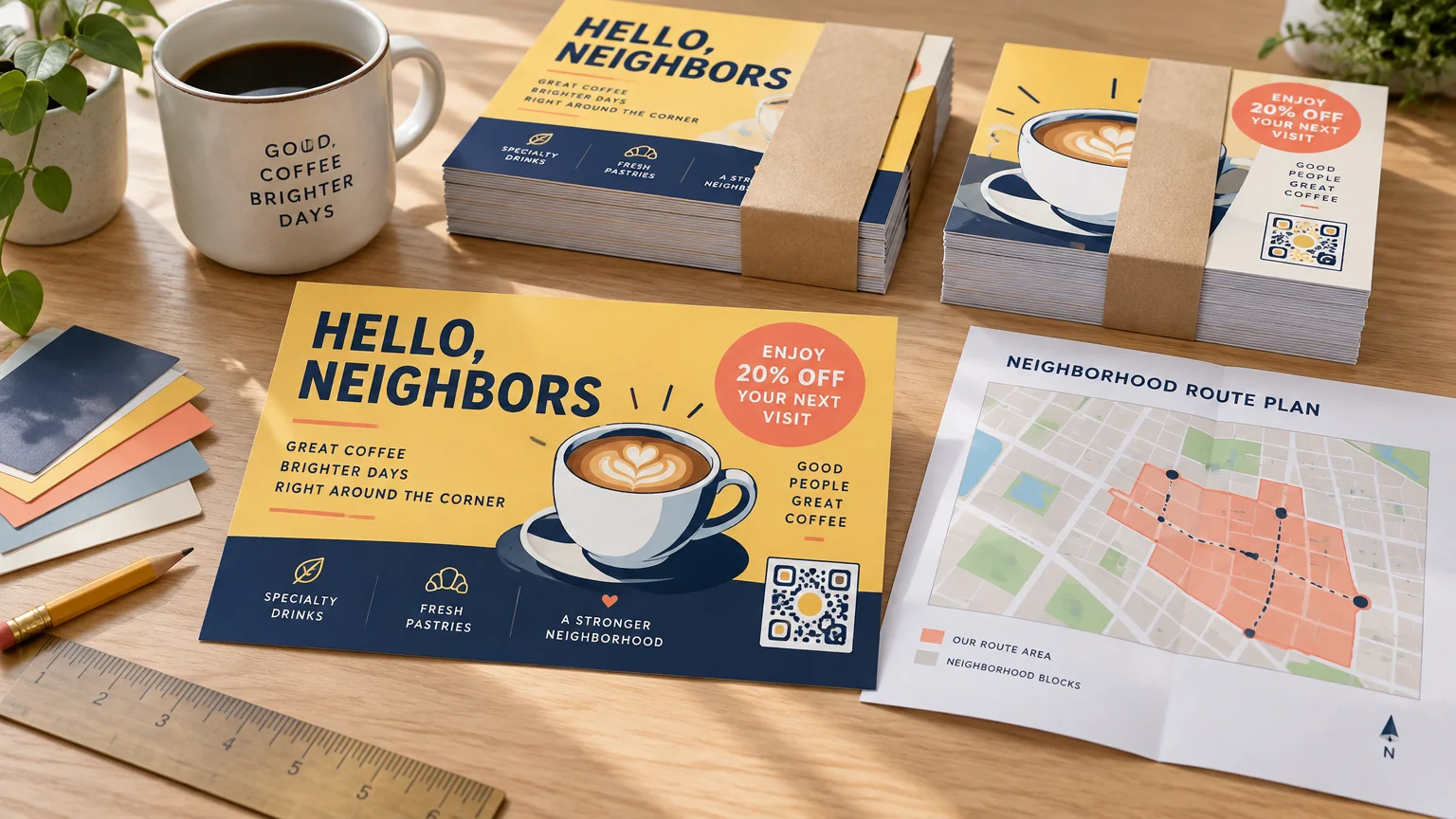
TLDR: EDDM stands for Every Door Direct Mail. It is a USPS service that delivers a printed promotion to every eligible address on selected carrier routes without requiring a list of individual names and street addresses. It works well for restaurants, home-service companies, local events, grand openings, and other campaigns aimed at broad neighborhoods. It is less suitable when you need personalized messages, individually selected households, or delivery on a guaranteed date.
If you are asking what is EDDM, the simplest answer is neighborhood-based direct mail. You choose postal carrier routes, prepare a qualifying flat mailpiece, pay postage, and take the organized mailing to the designated Post Office. Recipients generally see “Postal Customer” rather than their own names and addresses.
That distinction matters. EDDM is not a shortcut for reaching a carefully chosen list of past customers. It is a way to cover a geographic area efficiently. A pizza shop might send a menu to surrounding routes, while a landscaper might mail a seasonal offer across neighborhoods within its service area.
How EDDM works
The official USPS Every Door Direct Mail tool and guidance let you review carrier routes and use U.S. Census-based characteristics such as household size, age, and income while planning route coverage. These filters help narrow the geography, but the final mailing still goes to eligible addresses across the selected routes rather than to individually chosen people.
- Create or use a USPS account and open the EDDM Online Tool.
- Search an area and select the carrier routes that fit your service territory or promotion.
- Design and print a mailpiece that meets the applicable EDDM flat-mail requirements and carries the approved EDDM Retail indicia.
- Organize the pieces by carrier route, add the required facing slips, and complete the mailing paperwork.
- Pay the postage and take the prepared mailing to the Post Office identified for the selected routes.
For EDDM Retail, USPS describes bundles of 50 to 100 pieces, with the appropriate facing slip attached to each bundle. Route preparation is not an optional finishing detail: it is part of making the mailing acceptable.
What the customer receives
An EDDM piece can look like a large postcard, menu, promotional flyer, coupon sheet, or another rectangular flat mailpiece. The format should match the job. A restaurant may need enough room for a short menu and ordering details; a contractor may be better served by one strong before-and-after image, a seasonal offer, and a clear phone number.
Because the recipient did not request the piece, the front should explain itself quickly. Put the business name, core offer, and local relevance where they can be understood at a glance. Do not make someone decode a clever headline before learning what is being offered.
EDDM versus address-list direct mail
| Decision | EDDM | Address-list direct mail |
|---|---|---|
| Targeting method | Every eligible address on selected carrier routes | Specific names and addresses from a customer or purchased list |
| Personalization | Generally addressed to Postal Customer | Can support names, account details, or audience-specific versions |
| Best geographic use | Broad neighborhood coverage | Selected households, customers, prospects, or segments |
| Typical fit | Menus, openings, local services, events, coupons | Customer retention, lead nurturing, personalized offers |
| Main limitation | You cannot pick individual homes within a selected route | List acquisition, cleaning, addressing, and data quality add work |
Choose EDDM when location is the useful targeting signal. Choose address-list mail when identity, customer history, property type, or another individual attribute matters more than neighborhood coverage.
When EDDM is a good fit
- A restaurant wants to distribute a takeout menu around its location.
- A new shop wants broad awareness in nearby neighborhoods.
- A lawn-care, cleaning, roofing, or other service business wants to cover areas it can realistically serve.
- An organizer wants residents near a venue to know about a local event.
- A business has an offer with wide household relevance and does not need personal addressing.
- A campaign will repeat across selected routes to build local familiarity.
EDDM is less compelling when only a small number of individual addresses matter, the message contains personal information, or different recipients need different offers. It is also a poor match for a promotion that depends on arrival on an exact day. EDDM Retail uses USPS Marketing Mail, which does not include a guaranteed delivery date.
EDDM size and format rules
An EDDM Retail piece must qualify as an eligible USPS flat. According to the supplied USPS specifications, it must be rectangular, flexible, uniformly thick, no more than 3.3 ounces, and within the applicable ranges of 3.5 to 15 inches long, 3.5 to 12 inches high, and 0.007 to 0.75 inches thick. It must also meet at least one of the USPS flat criteria involving length, height, or thickness.
Those ranges should not be treated as a promise that any rectangle inside the outer limits will qualify. Orientation, proportions, thickness, flexibility, and the flat criteria all matter. Check the current USPS size tool before approving artwork, and ask the printer to confirm the finished dimensions, paper, folds, coatings, and weight.
Build the design at its final trim size and include the printer’s required bleed. Keep essential words, QR codes, and contact details safely away from trimmed edges. If you are preparing the file yourself, the same fundamentals used for other professional print artwork apply: correct dimensions, adequate image resolution, intentional color settings, and safe margins.
When requesting a quote from a commercial printing provider, identify the project as EDDM and ask whether the quote includes only printing or also bundling, facing slips, paperwork, and Post Office delivery. “EDDM printing” and “fully prepared for mailing” can represent very different scopes of work.
How much does EDDM cost?
Your campaign budget has at least two major parts: postage and production. It may also include design, route preparation, transport, landing-page work, or help from a mail-service provider.
The supplied USPS research displayed EDDM Retail postage of $0.26 per qualifying piece up to 3.3 ounces. That figure is time-sensitive and covers postage, not the complete campaign. Verify the current rate in the USPS tool before setting a budget or printing a quantity.
A 600-piece illustration
At the supplied $0.26 rate, postage for 600 delivery addresses would be approximately $156: 600 × $0.26 = $156. Printing, design, preparation, and fulfillment would be added separately. If printing and preparation hypothetically cost another $240, the working total would be $396, or $0.66 per delivered piece. That second figure is only an example calculation, not a current market quote.
EDDM Retail has no annual presort or mailing fee, according to USPS Postal Explorer. USPS states a general minimum of 200 pieces per mailing, subject to specified exceptions, and a maximum of 5,000 pieces per mailing per day at one Post Office. If a Post Office serves multiple ZIP Codes, USPS specifies a daily maximum of 5,000 pieces per five-digit ZIP Code.
EDDM Retail versus EDDM BMEU
EDDM Retail is the streamlined option commonly suited to smaller local campaigns. It does not require a special mailing permit. USPS distinguishes it from the Business Mail Entry Unit, or BMEU, workflow used for larger or more advanced mailings.
For a first neighborhood campaign of a few hundred or a few thousand pieces, EDDM Retail is usually the simpler option to investigate. For higher volumes, more complex preparation, or recurring programs, ask USPS or an experienced mail-service provider whether the BMEU route is more appropriate.
Design an EDDM piece people can act on
Postal compliance gets the piece delivered; design gives it a job. Start with one action rather than trying to reproduce an entire website on a mailer.
- Lead with one clear offer, announcement, or reason to care.
- Use a strong image that makes the business category immediately recognizable.
- Make the business name and service area easy to find.
- Give the offer a visible deadline when a real deadline applies.
- Choose one primary response path, such as a phone number, URL, QR code, or in-store coupon.
- Include supporting details only when they help someone make the next decision.
- Check readability at the printed size instead of judging only from a zoomed-in screen.
A trackable response path is particularly useful because EDDM itself does not tell you who looked at the piece. Use a dedicated landing page, QR code, coupon code, phone extension, or point-of-sale offer code. Record the campaign dates, routes, quantity, print cost, postage, and responses so you can compare later mailings without assuming a universal response rate.
Keep the printed offer consistent with the other places customers may encounter it. A coordinated email and social follow-up to a print campaign can reinforce the same message, although those channels will usually reach a different audience from the full carrier-route mailing.
Pre-print EDDM checklist
- Confirm that broad carrier-route coverage matches the campaign goal.
- Check the selected routes, delivery counts, address types, and designated Post Office in the live USPS tool.
- Verify the current postage rate and EDDM Retail quantity limits.
- Confirm that the finished piece qualifies as a flat, including its dimensions, thickness, flexibility, and weight.
- Place the current approved EDDM Retail indicia correctly.
- Proof the offer, dates, phone number, URL, QR code, and business address.
- Clarify who will print, bundle, create facing slips, complete paperwork, and transport the mailing.
- Allow scheduling flexibility because Marketing Mail does not have a guaranteed delivery date.
- Save route, cost, and response information for campaign review.
Common questions about EDDM
Do I need an address list?
No. EDDM is designed to reach eligible addresses on selected postal carrier routes without an individual name-and-address list. The pieces are generally addressed to Postal Customer.
Can I choose individual houses?
No. You select carrier routes rather than individual homes. If you need to include or exclude particular people or addresses, an address-list mailing is the better structure.
Does EDDM go to every house?
It goes to eligible delivery addresses on the carrier routes you select. Review the route information and address types in the USPS tool rather than assuming that a route contains only houses or that its boundaries match a neighborhood name.
Do I need a permit?
EDDM Retail does not require a special mailing permit. Larger or more advanced mailings may use the separate BMEU workflow, which has different procedures.
How long does delivery take?
USPS Marketing Mail does not provide a guaranteed delivery date. Build flexibility into the campaign, especially when promoting an event, opening, or short-lived offer.
The practical decision
EDDM is a practical choice when your ideal audience can be described as “people and businesses in these nearby routes.” It gives a local campaign broad physical reach without requiring an individual-address list, but that simplicity comes with tradeoffs: route-level rather than household-level targeting, strict mailpiece requirements, route preparation, and non-guaranteed timing.
Before designing, choose the routes and check their delivery counts. Then verify the current USPS rules and have the finished specification reviewed before authorizing the full print run. That order prevents the most expensive EDDM mistake: creating an attractive piece that cannot enter the mailing as planned.