
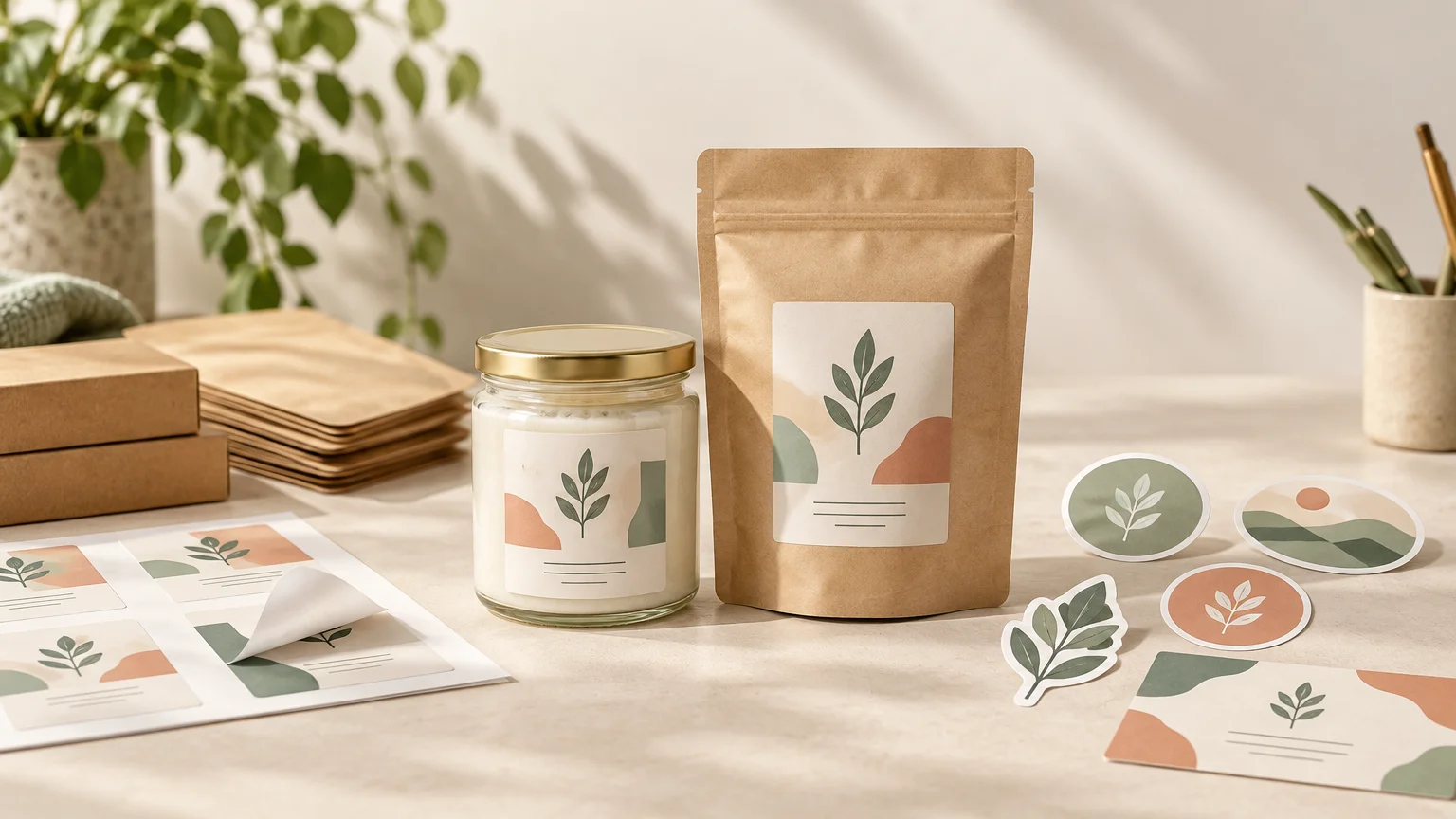
TLDR
Use product labels for information that must remain attached to an item: its name, variant, quantity, ingredients or instructions where applicable, and business details. Use promotional stickers as portable advertising, package extras, event handouts, seals, or branded giveaways. Many retail brands need both, but they should not make one design perform two conflicting jobs.
The simplest distinction is this: a product label serves the product, while a promotional sticker travels with the customer. That difference affects the message, material, adhesive, format, and quantity you should order.
Product labels and promotional stickers do different work
A good product label helps a shopper understand what an item is before asking them to admire the brand. On a candle jar, it might identify the scent and net weight. On a refrigerated sauce bottle, it may need to remain readable through condensation and repeated handling. On a cosmetic container, it must leave room for applicable identity, quantity, business, ingredient, and warning information.
Promotional stickers have more freedom. They can feature a logo, mascot, slogan, illustration, seasonal message, or QR code. A coffee shop can place one inside each online order, hand them out at a market, or use them to close tissue paper. The sticker is still branded, but it is not responsible for explaining the product.
| Decision | Product label | Promotional sticker |
|---|---|---|
| Primary job | Identify and explain the product | Build recognition and encourage sharing |
| Typical placement | Bottle, jar, box, pouch, tin, or container | Order insert, bag, laptop, notebook, event table, or package seal |
| Information density | Usually moderate to high | Usually low |
| Common format | Roll or sheet labels | Individually cut stickers or sticker sheets |
| Material priority | Compatibility with the package and storage conditions | Appearance, durability, and portability |
| Design priority | Fast comprehension and readable details | A bold, memorable idea |
Do not use a promotional sticker as a compliance shortcut
A handsome logo sticker does not automatically make a complete product label. For packaged foods in the United States, the FDA says the principal display panel carries the statement of identity and net quantity, while other required information may appear on the information panel. The agency’s Food Labeling Guide explains the broader framework.
Retail cosmetics are also subject to applicable labeling rules. FDA guidance identifies requirements that can include product identity, net quantity, firm information, and an ingredient declaration, with required statements presented prominently and conspicuously. FDA cosmetics labeling guidance is a useful starting point for U.S. sellers. Requirements vary by product and jurisdiction, so confirm the rules that apply to what and where you sell.
Promotional stickers can support that packaging, but they should not replace required information. Think of the label as part of the product system and the sticker as an optional brand experience.
Choose a format that matches your application workflow
Roll labels make sense when the same design will be applied repeatedly to jars, bottles, pouches, or boxes. They keep labels organized and can support a faster hand-labeling routine. Sheet labels are approachable for short runs and manual application because several labels arrive together on a manageable sheet. Individually cut vinyl stickers are better suited to handouts, order inserts, giveaways, and portable logo designs.
Current supplier options illustrate the range. CustomStickers lists roll-label materials including semi-gloss paper, permanent white or clear BOPP, holographic material, matte white material, and silver BOPP. Its listed roll sizes range from 1 × 1 inches to 7.16 × 7.16 inches and arrive on 3-inch cores. Its die-cut sheet labels come in listed 1-, 2-, 3-, and 4-inch options on 8.5 × 11-inch sheets.
For a coordinated order, CustomStickers custom stickers, labels, and material options cover both packaging labels and promotional vinyl stickers. Check the specifications for the exact product, destination, quantity, and finish before ordering because processing times and material descriptions can vary by product and market.
Match the material to the package, not just the artwork
Paper can be a sensible choice for dry, short-lived indoor packaging when cost and a traditional label feel matter most. Plastic films such as BOPP are generally the more relevant category when a label may encounter moisture, oil, refrigeration, or frequent handling. Clear material can let the container color show through, while metallic and holographic stocks create a deliberate specialty effect. The cited supplier distinguishes paper, plastic or BOPP, clear, foil, and specialty materials, and treats paper as an exception to its waterproof-label guidance.
Test the actual label on the actual container. A label that behaves well on a flat cardboard box may lift around a narrow bottle, struggle on a textured jar, or reveal bubbles on clear packaging. Fill the container, refrigerate or handle it as a customer would, and inspect the edges after a realistic interval.
For promotional stickers, durability can be part of the appeal. Standard vinyl options are commonly chosen for water bottles, laptops, notebooks, and outdoor-facing uses. CustomStickers lists die-cut vinyl stickers in 2- through 6-inch standard sizes, quantities from 50 to 20,000, and matte or gloss finishes. Its stated waterproofing and outdoor-life figures are supplier durability claims rather than independent test results.
Build separate artwork around separate priorities
Start the product label with an information hierarchy. Give the product name and variant immediate visual priority, then organize supporting details so the shopper does not have to rotate the package repeatedly. Keep essential text and logos inside the printer’s safe area, and extend background colors or images through the bleed. A shaped label should not be set up as though it were a rectangular flyer. For a fuller production checklist, use this guide to prepare print-ready files without the usual headaches.
Start the promotional sticker with one recognizable idea. A complicated miniature advertisement rarely becomes more appealing because it is die-cut. A strong silhouette, short phrase, mascot, or simple logo treatment is easier to notice and more likely to be kept.
If you add a QR code
Give the code enough room, contrast, and quiet space to scan reliably. The U.S. Department of Energy recommends testing it with a phone, using a short destination URL, explaining the destination nearby, and providing a text alternative or short link. DOE QR code best practices also reinforce an important design point: a mysterious square is not a call to action. Test a printed proof on several phones rather than trusting the screen preview.
A practical two-piece example
Imagine a small soap company selling three scents at local markets. Its product label should identify the soap and scent, carry the applicable quantity and business details, and remain legible through handling. A restrained rectangular or shaped BOPP label could be appropriate if moisture resistance matters.
Its promotional sticker can use the brand mascot and a short line such as “Small-batch, big lather.” That sticker can go into shopping bags or be offered at the checkout table. It does not need to repeat every package detail. The two pieces should share colors and typography, but each gets a layout built for its own job.
Use this ordering checklist
- Decide whether the piece must identify the product or promote the brand.
- List every required and useful piece of product information before choosing the label size.
- Measure the application surface, including curves, seams, and container taper.
- Choose paper, BOPP, clear film, vinyl, or a specialty stock according to real handling conditions.
- Select rolls for repeated application, sheets for manageable hand labeling, or individual stickers for distribution.
- Prepare separate artwork for the label and promotional sticker instead of shrinking one design into both formats.
- Order or review a proof, then test adhesion, legibility, color, cut position, and any QR code.
- Allow time for proofs, revisions, production, and shipping rather than planning around production time alone.
The best small-brand choice is often both
Choose a product label when the print must stay with the item and help the customer identify, understand, or use it. Choose a promotional sticker when you want the brand to travel beyond the product. If the budget allows both, create a clear, durable label first and add one visually confident sticker as the shareable extra. That small division of labor usually produces better packaging and better promotion than asking one crowded design to do everything.
References
- Food Labeling Guide
- Summary of Cosmetics Labeling Requirements | FDA
- Sticker Rolls | High Quality & Cost Effective – CustomStickers.com
- Die Cut Sheet Labels | Quality Packaging and Product Labels – CustomStickers.com
- Shipping FAQ – CustomStickers.com
- Custom Labels | Premium Quality | Lowest Prices – CustomStickers.com
- Clear Label Rolls – CustomStickers.com
- Custom Vinyl Stickers | Waterproof and Durable – CustomStickers.com
- Custom Stickers | Fast & Free Shipping – CustomStickers.com
- Bleed and Safe Area for Flyers, Cards, and Small-Business Print – Ikeni Prints
- QR Code Standards and Best Practices | Department of Energy