
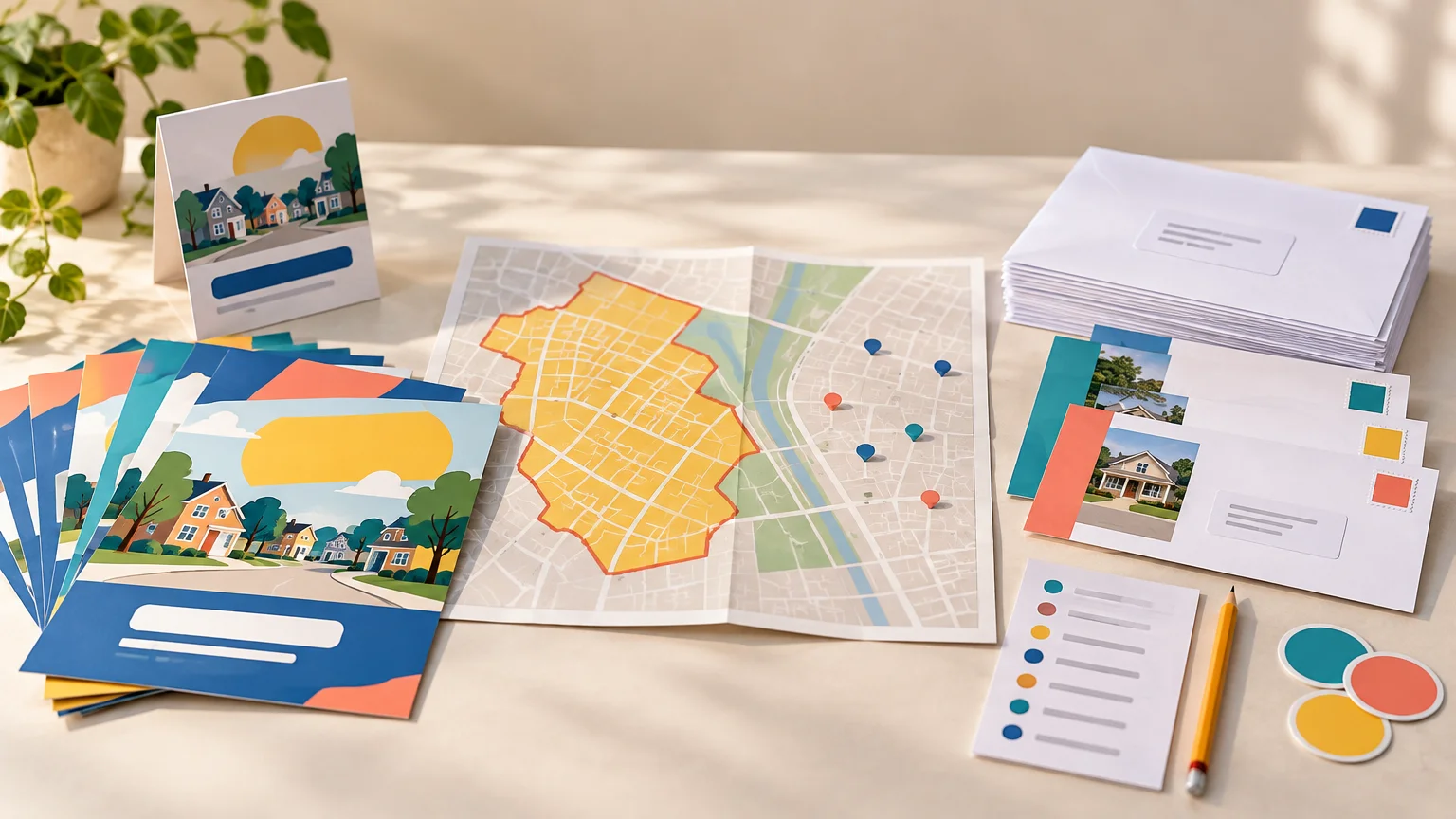
The simplest answer is this: choose Every Door Direct Mail when you want broad coverage in specific neighborhoods, and choose address-list direct mail when reaching the right individuals matters more than reaching nearly every door.
EDDM is not really a separate channel from direct mail. It is a USPS Marketing Mail option that sends qualifying flat mailpieces to delivery points along selected carrier routes. Instead of putting a person’s name and full address on each piece, you select routes and use an approved simplified address such as “Postal Customer.”
TL;DR
- Choose EDDM for restaurant openings, neighborhood services, local events, retail promotions, real estate farming, and other offers relevant to most nearby households.
- Choose addressed direct mail for customer reactivation, carefully defined prospect lists, appointment reminders, donor outreach, loyalty offers, and campaigns that benefit from personalization.
- Compare the total campaign cost, not postage alone. Printing, design, list work, preparation, transport, landing pages, and response handling can all affect the final number.
- Use one strong offer, a clear deadline, and an easy response path regardless of mailing method.
EDDM and addressed direct mail at a glance
| Decision | EDDM | Address-list direct mail |
|---|---|---|
| Targeting | Selected carrier routes | Selected individual records |
| Addressing | Approved simplified designation | Recipient name and delivery address |
| Personalization | One shared design and offer is typical | Can support variable names, offers, codes, or locations |
| Best fit | Broad neighborhood relevance | Defined customer or prospect groups |
| Main tradeoff | Some recipients may not fit the offer | More list preparation and address-quality work |
| Format flexibility | EDDM Retail requires a qualifying flat | Depends on the postal product and applicable mailpiece rules |
Choose EDDM when geography is your best filter
EDDM works well when most homes in a selected area could reasonably use what you sell. A new pizza shop, neighborhood gym, landscaping company, community festival, or home-cleaning service may care more about distance than a recipient’s identity.
The USPS EDDM route-selection system lets you review carrier routes using route-level information such as residential counts, household size, age, income, and estimated cost. These controls help you choose neighborhoods, but they do not select individual households within a route.
That distinction is important. If a route has 600 delivery points and only 100 are strong prospects, EDDM generally does not let you mail only to those 100 records. Its convenience comes from covering the route without building an individual-address list.
EDDM Retail is particularly approachable for smaller campaigns. USPS requires at least 200 pieces and permits up to 5,000 pieces per day per ZIP Code. It does not require a special mailing permit, although you need a USPS.com account and must take the prepared mailing to the designated Post Office. Larger campaigns can use Business Mail Entry Unit entry, which requires additional business-mail accounts and permitting.
If you need a fuller walkthrough of route selection and preparation, start with how EDDM works.
Choose addressed direct mail when the list creates the advantage
Addressed direct mail earns its extra preparation when you already know whom you want to reach. A dental practice might contact patients due for a visit. A theater might mail past ticket buyers. A service company could send a specific maintenance offer to customers who purchased a particular system.
You can include or omit individual records rather than paying to reach an entire route. When the printer and production workflow support variable data, the same design can also carry different names, offers, locations, images, codes, or landing-page destinations.
For designers building this type of piece, Adobe’s InDesign Data Merge documentation explains how a shared layout can be combined with a data file in which rows represent records and columns represent fields. Printer capabilities vary, so confirm supported fields, file formats, proofing procedures, and postal preparation before designing an elaborate personalized campaign.
The mailing list also needs proper maintenance. USPS says commercial Marketing Mail addresses generally must meet Move Update requirements within 95 days before mailing, while ZIP Code accuracy verification or correction is generally required within six months.
Do not compare postage alone
USPS currently lists EDDM Retail postage at $0.26 per qualifying flat weighing up to 3.3 ounces, with BMEU EDDM pricing advertised as low as $0.259 per piece. Rates can change, and those figures cover postage rather than the entire campaign.
Your real comparison should include design, printing, mailing-list acquisition or cleanup, personalization, bundling, paperwork, transport, mailing-service fees, and response tracking. An EDDM campaign can have simpler data preparation but still waste money if the offer applies to only a small fraction of each route. Addressed mail can cost more to prepare while producing a more focused campaign.
Before ordering, compare suitable sizes, stocks, finishes, and other custom print products and production options. Then request quotes using the same quantity and comparable specifications so the totals are meaningful.
Check the format before designing an EDDM piece
EDDM Retail pieces must qualify as flats and weigh no more than 3.3 ounces. A piece must exceed at least one USPS flat threshold: 10.5 inches long, 6.125 inches high, or 0.25 inch thick. The USPS checker lists outer ranges of 3.5 to 15 inches long, 3.5 to 12 inches high, and 0.007 to 0.75 inch thick.
The design also needs an EDDM Retail indicia in the upper-right addressing area. USPS specifies an indicia larger than 0.5 by 0.5 inch, with all-capital text of at least 4 points, kept within the designated clear area.
Do not assume an attractive postcard size automatically qualifies. Confirm the finished dimensions, thickness, weight, orientation, addressing panel, and indicia with USPS and your printer before approving production. Build bleed and safe margins into the artwork as well; this bleed and safe-area guide explains how to keep critical content away from the trim edge.
A quick decision test
Imagine two businesses mailing 2,000 pieces. A new neighborhood restaurant wants nearby households to try a family meal offer. Geography defines the audience, the same promotion applies broadly, and a large visual mailer can show the food clearly. EDDM is the natural starting point.
Now imagine an appliance service company with a list of customers whose service plans expire this season. Mailing every door would reach many irrelevant households. An addressed campaign can focus on known customers and vary the message or code by record. The list supplies the value, so addressed mail is the stronger fit.
Make the mailpiece easy to act on
Whichever method you choose, give the piece one job. Lead with a specific offer or reason to respond, make the business name obvious, show the service area when relevant, and provide one prominent action such as calling, visiting a short URL, bringing in a coupon, or scanning a tested QR code.
I would choose EDDM when the offer is broadly useful and the map defines the market. I would choose addressed direct mail when the recipient list is an asset rather than an administrative chore. Decide that first, confirm the postal rules second, and only then finalize the size and artwork.
References
- USPS Marketing Mail | Postal Explorer
- Every Door Direct Mail (EDDM) – Targeted Mail Marketing | USPS
- 602 Addressing | Postal Explorer
- Every Door Direct Mail | USPS
- Data source files in InDesign | InDesign
- Data merge overview in InDesign | InDesign
- Every Door Direct Mail (EDDM) – Targeted Mail Marketing | USPS
- Every Door Direct Mail | USPS